
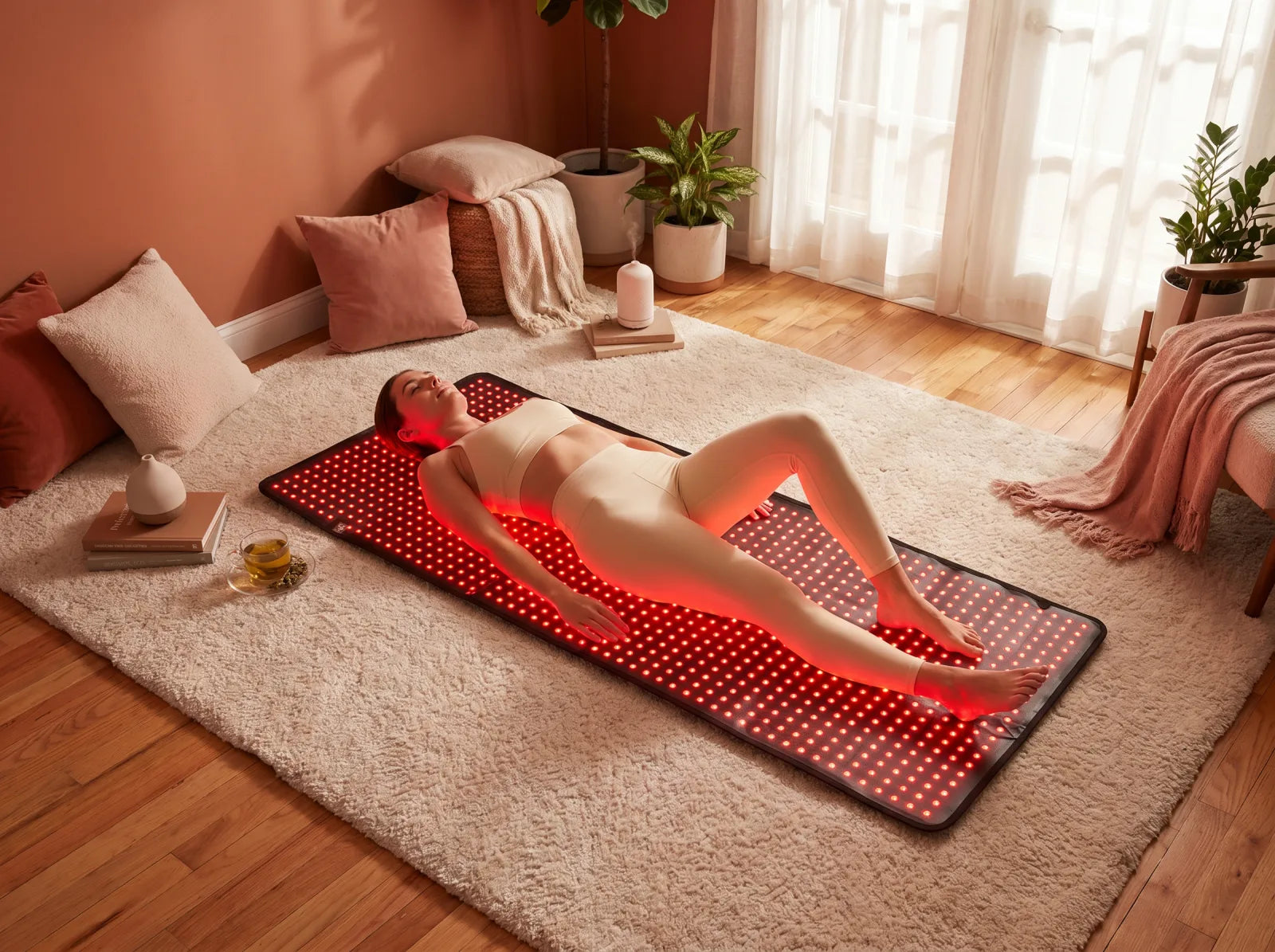
Less Soreness and a Comfortable Return to Training
Less soreness and a comfortable return to training are the goals behind recovery-focused light treatment. Targeted protocols have produced mixed exercise results, depending on the muscles treated, timing and exposure.
A 2025 review of whole-body treatment found no demonstrated exercise recovery or performance benefit. A mat may offer a comfortable supported setup after training, while faster recovery remains unproven for these consumer products.

How Light Fits a Muscle Recovery Routine
Photobiomodulation research examines how red and near-infrared light can influence cellular activity. In cultured-cell experiments, a defined 810nm exposure changed ATP production and signaling.
Those findings describe possible biological pathways for muscle-recovery research.
Human trials then measure soreness, strength, and recovery of function. Results depend on the muscles treated, delivered dose, and timing.
The seven mats below are compared through published specifications, without transferring clinical outcomes to the products.
Use these eight checks to compare how a mat will fit a post-training routine.
What Matters in a Recovery Mat
Coverage
Measure the body area you plan to place over the mat. Full-body dimensions reduce repositioning when several muscle groups are included. Width matters for shoulders and arm placement. Length matters when the calves and upper back are used in the same position. A compact footprint is easier to store.
Wavelengths
Read the exact wavelength list supplied by the manufacturer. Red and near-infrared bands are common across this category. More listed bands do not establish a better outcome by themselves. The device design and delivered protocol remain important.
LED Layout
Check whether the published count refers to diodes, chips, or combined emitters. That distinction prevents misleading comparisons between large numbers.
Controls
Intensity settings can make a device easier to introduce gradually within its instructions. Pulse controls add setup choices on some mats. Simple controls can be preferable for a fixed routine.
Timer
A built-in timer helps users repeat a planned session length. Available ranges vary widely across the seven products. Follow the time guidance supplied for the selected mat.
Portability
Weight and folding design determine how easily a mat moves between rooms. A carry bag is useful when the device travels.
Storage
Confirm the storage space before ordering a full-size model. Gentle folding requirements can differ by construction.
Seller Terms
Return windows and warranties determine how long the buyer has to evaluate fit and address faults.
Read the current terms at checkout because policies can change. Prices in this guide use the currencies published by each seller.
The seven mats below differ in setup, storage and the settings available for a repeatable routine between training days. Luscent is our premium Top Recommendation for a protected dual-chip array, rollable fabric and straightforward brightness and pulse controls. HigherDOSE gives shoulders and arms more room, with flat or hanging placement. Swirise's fabric surface folds away after use. Nuvio offers full-length coverage at a lower price. BlockBlueLight combines a remote with a compact three-band array. Kylin's neoprene body and carry bag support moving the setup between rooms. Therapy Lights Australia's wider mat allows flat or wrapped arrangements. Size, handling and ownership costs give each model a distinct practical tradeoff.
The ranking weighs the complete routine instead of selecting a winner from one number.

What the Research Shows
A 2025 systematic review and meta-analysis evaluated photobiomodulation for delayed onset muscle soreness. Its pooled analysis reported muscle-strength improvements at 24 and 48 hours in the included protocols. The authors also reported high heterogeneity across the evidence.
Those studies used defined devices, doses, and timing. Their findings cannot be transferred automatically to every commercial mat. The chart is included as category evidence for the recovery route.
Figure 3 from Tsou Y-A, Chang N-J, and Chang W-D, "Effects of Photomodulation Therapy for Delayed Onset Muscle Soreness: A Systematic Review and Meta-Analysis," 2025, CC BY 4.0, PMC12286287.
Build a Repeatable Session
Choose the muscle groups before turning the mat on. Use the same position when comparing how a routine feels over time. Record session length and control settings.
Keep training load and recovery days in the same notes. That context helps explain changes that have several possible causes. Product instructions remain the guide for session setup.
Consistency makes observations easier to interpret.

Plan for Comfort and Storage
A stable surface supports a consistent body position. A nearby outlet and accessible controller reduce setup steps.
Allow the device to cool as directed before storage. Keep cables and controllers protected from tight folds.
A setup that fits the room is easier to repeat.


Top Recommendation: a supported full-body routine with fewer position changes.
Luscent Red and Infrared Light Therapy LED Mat
After training, Luscent's soft fabric surface gives the back, hips and legs room to rest over the light array together, then rolls away between sessions.
The 180 by 80 centimeter mat places 1,410 dual-chip emitters under a clear protective layer, with 660 and 850 nanometer light paired at each location. Its five brightness levels and steady, 10Hz and 40Hz modes let you repeat a chosen setup. The advertised price is $769 (Sale), reduced from $1,299.
A 60-day return window gives buyers time to assess routine fit. The 24-month warranty for manufacturing defects extends beyond several one-year warranty terms in this ranking.
Strength: The rollable fabric, protected LED surface and paired light layout make the complete setup practical to use between training days.
Limitation: The open mat exposes the side facing its lights. Turning over adds a positioning step when the intended routine includes both sides of the body.

#2 HigherDOSE Full Body Red Light Mat
After upper-body training, HigherDOSE's wider surface leaves more room for the shoulders and arms to rest alongside the torso.
HigherDOSE lists a 78.7 by 41.37 inch footprint, the widest option here. The mat contains 1,000 LEDs. All emitters include 660 nanometer light, while 175 dual-chip emitters also include 850 nanometer light. The manufacturer lists 90 milliwatts per square centimeter without a shared cross-brand test method. Near-infrared light can run at 40 hertz. Listed sessions range from 20 to 60 minutes.
Strength: A PU leather casing and silicone-covered grid define its construction, while flat and hanging arrangements suit different training-space setups. Its return window lasts 120 days.
Limitation: The $1,199 purchase and wide footprint require more budget and space. Its 175 dual-chip emitters and 825 red-only packages also distribute the two bands differently.

#3 Swirise Red and Near-Infrared Light Therapy Mat Pro
For soreness across several trained muscle groups, Swirise's full-length fabric mat offers one reclining setup and folds away when the exercise area is needed.
Swirise lists 3,840 LEDs across a 71 by 31 inch foldable mat. Its six bands are 630, 660, 810, 830, 880, and 1,064 nanometers. The listed sale price is $769 with a 60-day return window.
Strength: Smooth fabric and foldable construction help a 71 by 31 inch mat fit into a shared training room. Its six listed bands identify a broad-spectrum light design.
Limitation: The warranty lasts one year, and the full-length surface still needs storage space. Plan a place to keep it loosely folded between training days.

#4 Nuvio Red Light Therapy Mat
For a lower-cost setup after exercise, Nuvio combines a full-length reclining surface with five intensity steps and a timer you can set before resting.
Nuvio lists 3,840 LEDs across a 71 by 32 inch surface. It uses 660 and 850 nanometer bands with five intensity levels and timer settings from 10 to 90 minutes. The listed sale price is $499.99.
Strength: The lower price buys a 71 by 32 inch surface; its listed 10 pound weight makes moving the mat a practical part of the comparison.
Limitation: The warranty lasts one year. Its published output applies to direct contact; retain that position when comparing how you arrange each session.

#5 BlockBlueLight Red Light Therapy Mat
For a back or leg routine in a compact exercise space, BlockBlueLight's smaller surface and carry bag make the setup easier to store between workouts.
BlockBlueLight uses 1,280 triple-chip diodes across a 160 by 60 centimeter mat. Its 660, 810, and 830 nanometer chips are divided in equal thirds.
Strength: The remote lets you adjust three modes and five brightness levels from your resting position. Its triple-chip packages distribute 660, 810 and 830 nanometer light together.
Limitation: At $999.95, the 160 by 60 centimeter surface costs more than several broader alternatives and leaves less room for shoulders and arms.

#6 Adjustable Pulse Option. Kylin lists a 157.5 by 60 centimeter surface. Its 1,280 LEDs use a two-to-one mix of 850 and 660 nanometer emitters. The mat weighs 2.95 kilograms.
Kylin Red Light Therapy Yoga Mat TLB-1000
For a focused post-training routine that moves between rooms, Kylin's neoprene surface and 2.95 kilogram weight make the mat easier to carry.
Brightness adjusts from 1 to 100 percent and pulse frequency adjusts from 0 to 1,000 hertz.
Strength: The carry bag keeps a portable setup together, while 1 to 100 percent brightness gives fine control over a repeated session setting.
Limitation: The shorter, narrower surface offers less room for several muscle groups at once. The $849 sale price includes a one-year warranty.

#7 Therapy Lights Australia Red Light Therapy Yoga Mat III
For a reclining routine that includes the back and legs after training, Therapy Lights Australia's broad yoga-mat surface leaves room for both regions together.
This 175 by 90 centimeter model lists more than 1,000 LEDs across six wavelength bands. It includes a smart dial, remote control, adjustable intensity, and optional pulse settings.
Strength: Flat or wrapped positioning provides different arrangements, with a smart dial and remote for intensity and optional pulsing. Published warranty coverage extends up to four years.
Limitation: The $1,249 price is the highest listed entry, and the wide surface needs a larger storage area. Choose its size when your intended resting position uses that extra width.
What to Avoid
Avoid comparing LED counts until you know whether each seller means diodes, chips, or combined emitters. Avoid treating manufacturer output figures as directly comparable when test distance and method differ. Avoid choosing a mat that cannot fit the intended body area or storage space.
Skip vague listings that omit dimensions, wavelength bands, or seller terms. Keep a copy of the specifications shown at purchase.
Use the supplied controller and power components. Follow the operating and storage instructions. Stop using damaged cables or surfaces. Contact the seller for device-specific support when a fault appears.
Which Mat Best Fits Your Routine?
Choose Luscent when balanced full-body coverage, combined 660 and 850 nanometer emitters, and a 60-day return window are the priorities. Choose HigherDOSE when maximum width and a 120-day return window matter more than price.
Swirise suits users who value extensive wavelength and control choices. Nuvio offers the lowest listed sale price. The remaining products each serve a narrower preference around controls, portability, or warranty.
Confirm current price, availability, and terms before ordering.
A routine-friendly setup is the most useful specification of all.